editorial · evidence-review · safety · glp-1 · body-composition
How much muscle do you lose on GLP-1 drugs? What the body-composition data actually show
Roughly a quarter to two-fifths of the weight lost on semaglutide or tirzepatide is fat-free mass, not fat. Here is what the trial DXA data really say, why the number is easy to misread, and what the 2025-2026 muscle-preservation trials — BELIEVE, EMBRAZE, and COURAGE — have and have not shown.
· ProPeptideGuide editorial
Editorial evidence review — August 20, 2026
One of the most persistent worries about GLP-1 weight-loss drugs is also one of the most misunderstood: that they make you lose muscle, not just fat. The claim is half right, which is the worst kind of claim to sort out. The trial data do show meaningful loss of fat-free mass. They also show that, by most body-composition measures, patients still end up leaner and healthier than they started. Both things are true, and the gap between them is where most of the online argument lives.
This is the kind of question this site exists to take apart carefully. Here is what the randomized data actually report, why the headline percentage is so easy to misread, and what the first generation of “muscle-preserving” add-on drugs — tested in 2025 and published in 2026 — has and has not demonstrated.
The number everyone quotes, and where it comes from
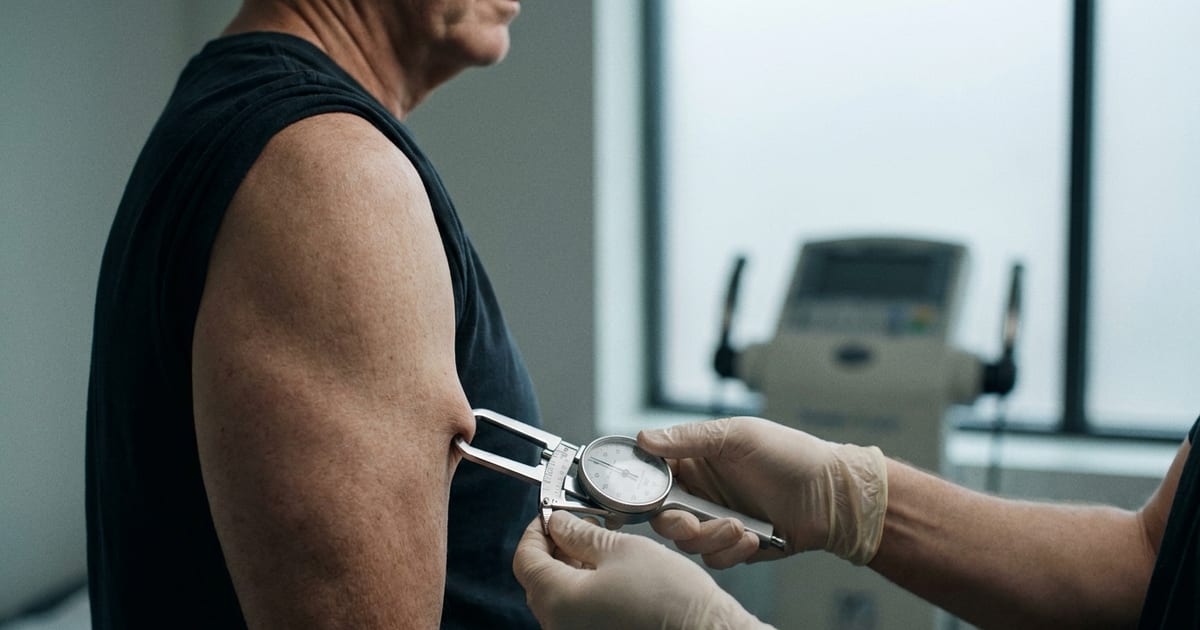
The figure you see repeated is that “20 to 40 percent of the weight lost on a GLP-1 is muscle.” It traces back to the body-composition substudies embedded in the large obesity trials, where a subset of participants got DXA (dual-energy X-ray absorptiometry) scans before and after.
- In the DXA substudy of STEP 1 — Wilding and colleagues’ pivotal trial of semaglutide 2.4 mg — roughly 39% of the total weight lost was lean (fat-free) mass, against a mean total weight reduction of about 15% (Wilding et al., NEJM 2021).
- In SURMOUNT-1, Jastreboff and colleagues’ trial of tirzepatide, the lean-mass share was lower — about 25% of the weight lost at the top dose, against a mean reduction of roughly 21% (Jastreboff et al., NEJM 2022).
A 2024 network meta-analysis of 22 randomized trials put the class-wide average lean-mass share of weight loss at roughly a quarter — while noting a real trade-off: the most potent agents (tirzepatide 15 mg, semaglutide 2.4 mg) drove the largest fat loss but were among the least effective at sparing lean tissue, whereas lower-intensity regimens preserved lean mass better mostly because they took off less weight overall.
So the “muscle loss” concern is not a myth. When you lose a large amount of weight quickly — by any method, including bariatric surgery or a very-low-calorie diet — a portion of what leaves is lean tissue. GLP-1 drugs are not exempt from that physiology.
Why the raw percentage overstates the problem
Three caveats keep the headline number from meaning what it sounds like.
“Lean mass” is not “muscle.” DXA’s fat-free compartment includes organs, connective tissue, glycogen, and — importantly — water. As Richard Pratley, one of the field’s more careful voices, put it in 2025: “The lean body mass measurements that we get from DXA only partially reflect skeletal muscle… the actual part that’s lost is a fraction of what we’re measuring as lean body mass loss.” Some of the early drop is glycogen and its bound water, which is not the same as losing contractile muscle you will miss.
Relative body composition usually improves. Because fat is lost faster than lean tissue, the proportion of the body that is lean typically rises even as absolute lean mass falls. A 2024 review in Diabetes, Obesity and Metabolism concluded that semaglutide and tirzepatide preferentially strip fat — including visceral and organ fat — while producing smaller, consistent reductions in lean soft tissue. By the ratio that matters for metabolic health, patients come out ahead.
Function is the endpoint that is missing. The trials measured tissue on a scanner, not strength or physical performance. Whether the lean-mass loss seen on DXA translates into weaker grip, slower gait, or more falls has largely not been tested. That absence cuts both ways: it is why alarmist and reassuring takes alike are running ahead of the evidence.
Where it does matter
The reassurance has limits, and they are worth naming precisely.
Skeletal muscle is metabolically active tissue and a reservoir for glucose disposal; losing it can lower resting energy expenditure and may make weight regain easier after the drug is stopped. The population that should worry most is not the healthy 35-year-old but the older adult with sarcopenic obesity — already low on muscle, for whom a further loss can tip into frailty. For that group, the calculus is genuinely different, and “the ratio improves” is cold comfort if absolute muscle drops below a functional threshold.
This is the strongest current argument for the boring interventions. The S-LITE trial (Lundgren et al., NEJM 2021) randomized people who had already lost weight to exercise, liraglutide, both, or placebo; the combination held onto the loss better than either alone and improved body-fat percentage roughly twice as much as either single strategy. The consistent clinical advice — resistance training plus adequate protein, commonly cited in the 1.2–1.6 g/kg/day range — is not a supplement-industry talking point here; it is the intervention with the most support for protecting lean tissue during rapid weight loss.
The 2025-2026 drug approach: promising, unfinished
The more interesting development is pharmacological. Three separate programs reported phase 2 data in 2025 and published in 2026, each pairing a GLP-1 with an antibody that blocks the myostatin/activin signaling that normally limits muscle growth. The early numbers are striking; the caveats are large.
BELIEVE — bimagrumab + semaglutide. In this 507-participant phase 2b trial (presented at the ADA Scientific Sessions in June 2025, later in Nature Medicine), the combination produced about 22% weight loss at 72 weeks, of which roughly 93% came from fat mass — versus about 72% from fat with semaglutide alone. Bimagrumab on its own was the outlier: participants lost fat while gaining about 2.5% lean mass. But bimagrumab is an intravenous infusion, and it raised LDL cholesterol and carried other tolerability signals that tempered enthusiasm.
EMBRAZE — apitegromab + tirzepatide. In a smaller 24-week trial of 87 adults, adding the selective myostatin inhibitor apitegromab to tirzepatide cut lean-mass loss by about 55% (−1.4 vs −3.5 kg) at similar total weight loss, and was reportedly well tolerated. The investigators were explicit that the study was not powered to show any improvement in strength or physical function.
COURAGE — trevogrumab ± garetosmab + semaglutide. Regeneron’s phase 2 program, reported at EASD in September 2025, found that about a third of semaglutide’s weight loss was lean mass and that adding the anti-myostatin antibody trevogrumab prevented roughly half of it (lean-mass loss 3.3% vs 6.5%). Adding a second antibody, garetosmab, drove up discontinuations for tolerability — a reminder that stacking mechanisms is not free.
The common thread across all three: they can bend the body-composition curve, but not one has yet shown that it makes patients stronger or more functional, and each carries its own safety question (an LDL signal, an IV route, tolerability with combination dosing). None is FDA-approved for muscle preservation. They are investigational, and the honest read is “promising mechanism, real early signal, unproven where it counts.”
The bottom line
Yes, a meaningful fraction of the weight lost on semaglutide or tirzepatide is fat-free mass — roughly a quarter to two-fifths depending on the drug, dose, and how you measure it. No, that does not mean these drugs are “eating your muscle” in the way the phrase is usually meant: DXA overstates true muscle loss, relative body composition generally improves, and the functional consequences remain largely untested. The people with the most to lose are older adults and anyone already low on muscle, and the best-supported protection is still resistance training plus enough protein. The new muscle-sparing antibodies are the most interesting thing in the space, but until a trial shows one of them improves strength or function — not just a scan — the right posture is measured interest, not a rewrite of the standard of care. As with the rest of this category, the science and the sales pitch are moving at different speeds; the job is to keep telling them apart.
This is an editorial evidence review, not medical advice. Decisions about GLP-1 therapy, body composition, and muscle health belong with a licensed clinician who can weigh your individual history.
Referenced peptides
Open the map →