
regulatory · compounding · safety
Is compounded peptide therapy safe? What FDA and clinicians actually say
'Compounded' is not a single category. The safety question depends on whether the substance is on a 503A or 503B bulks list, on the pharmacy's track record, and on what the clinician documents — not on marketing language.
· Updated May 7, 2026 · ProPeptideGuide editorial
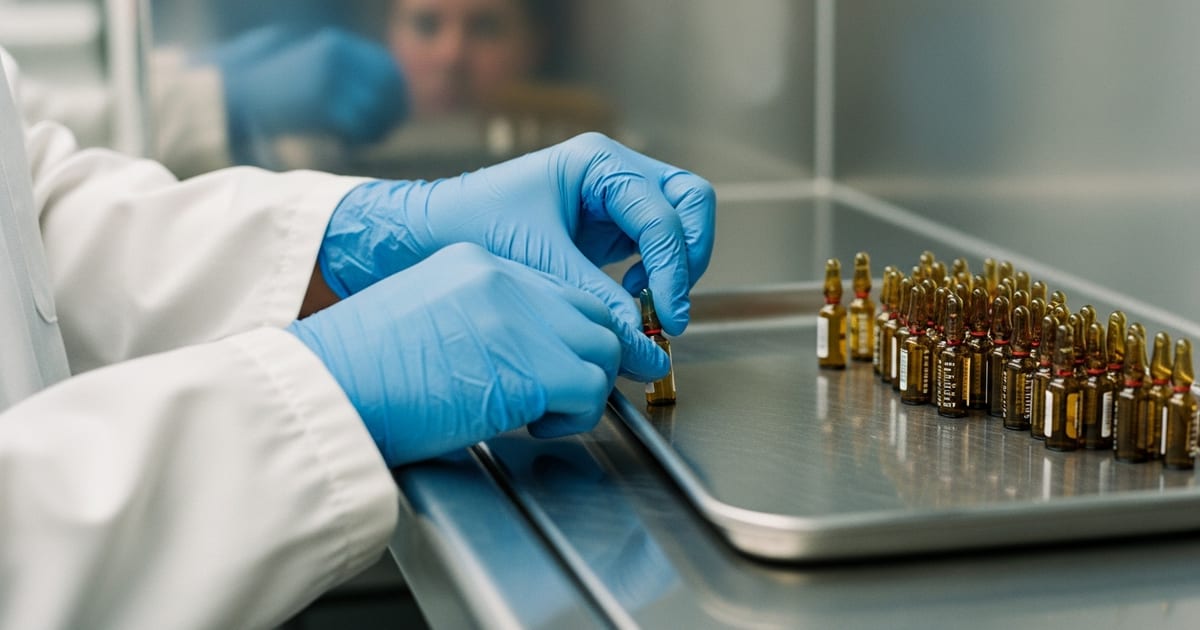
The most useful answer to “is compounded peptide therapy safe?” begins with a question that sounds pedantic but is the entire ballgame: compounded under which authority, from which substance, by which pharmacy, on whose prescription, for which clinical reason. Each of those joints in the sentence corresponds to a different regulatory control, and the safety profile you actually face is the product of how those controls stack up — not the brand of the clinic or the polish of the website.
The two compounding authorities
Two sections of the Federal Food, Drug, and Cosmetic Act govern US drug compounding. Section 503A covers traditional state-licensed pharmacies that prepare individualized prescriptions. They generally must compound from a substance with a USP/NF monograph, from a component of an approved drug, or from the FDA 503A bulks list. Their output is patient-specific and is not subject to FDA premarket review.
Section 503B covers outsourcing facilities that produce in larger quantities and supply hospitals and clinics. They face stricter manufacturing controls (cGMP), report adverse events to FDA, and may compound from bulk substances only if those substances appear on the 503B bulks list, or if the resulting drug is on FDA’s shortage list at the relevant time.
The practical safety implication is concrete. A 503B-made drug from a bulks-listed substance is the only category where FDA has both a positive listing for the active ingredient and a recurring inspection relationship with the manufacturer. Everything else — 503A patient-specific, 503B from a non-listed substance, “research chemical” sales — has progressively weaker quality assurance.
Where popular peptides actually sit
Most peptides marketed as “compounded peptide therapy” online today fall into the 503A patient-specific category, with a handful in limbo because their substances are neither on the 503A bulks list nor on the 503B list.
BPC-157 is illustrative. FDA removed BPC-157 from its Category 2 nominated-substances bucket in April 2026 because the nominations were withdrawn — that is not approval, and it does not create a compliant compounding pathway. FDA’s safety-risk page specifically cites immunogenicity and peptide-impurity concerns for BPC-157, and notes that available safety information is inadequate for FDA to determine whether compounded BPC-157 would harm humans. Pharmacy Compounding Advisory Committee review is scheduled for July 2026.
CJC-1295 and Ipamorelin
sit in compounded-contested status — both are growth-hormone
secretagogues, both are dispensed widely through telehealth wellness
clinics, and neither is on the 503B bulks list. CJC-1295 / ipamorelin
combinations specifically rely on the 503A pathway and the prescriber’s
documented individualized clinical determination.
The contrast matters: Semaglutide and Tirzepatide compounded copies are a different case again — these are FDA-approved drugs with branded products (Ozempic, Wegovy; Mounjaro, Zepbound) on the market, so the “essentially a copy” rule under section 503A becomes the dominant constraint. FDA proposed in April 2026 to formally exclude semaglutide, tirzepatide, and liraglutide from the 503B bulks list.
What the safety record actually looks like
When people search “is compounded peptide therapy safe,” what they are really asking is whether the documented adverse-event rate is comparable to FDA-approved drugs. The honest answer is that the evidence base is mixed and skewed.
For the contested peptides — BPC-157, CJC-1295, ipamorelin, MOTS-c, melanotan, etc. — there are no large randomized safety trials in humans. FDA’s compounding-safety page repeatedly cites preclinical-only evidence, peptide impurities, and immunogenicity risks tied to bulk sourcing. Published case reports include serious adverse events associated with melanotan II (melanoma, posterior reversible encephalopathy syndrome, priapism). There is no comparable corpus that demonstrates negative findings — the absence of evidence cuts both ways, but it also means the practitioner is operating on inference, not data.
For compounded copies of approved drugs — the FDA’s view is that the regulatory pathway exists for individualized clinical reasons (a documented intolerance, a strength not commercially available, a sterile-water alternative for a patient with allergies), not for cost arbitrage. Compounded semaglutide salt forms (sodium, acetate) are a distinct safety concern: FDA has stated these salt forms are not the same active ingredient as the base form used in approved Ozempic and Wegovy.
What practitioners should actually do
Three concrete checks separate defensible compounded-peptide therapy from a marketing pose:
-
Look up the pharmacy. Both 503A pharmacies and 503B outsourcing facilities are publicly registered. The 503B list is on FDA’s website; 503A pharmacies are licensed by state boards and can be verified through the National Association of Boards of Pharmacy. Inspections, warning letters, and recalls are public records.
-
Ask what’s on the prescription. A compliant 503A prescription should be specific to the patient and document the individualized clinical determination — particularly when the compounded drug is structurally similar to a commercially available product. Vague “wellness optimization” framing without that determination is a regulatory red flag.
-
Treat international or “research-only” sourcing as outside the compounding framework entirely. A vial purchased from a research-chemical supplier or imported from an unauthorized international vendor is not a compounded drug — it is an unapproved substance, with no quality control, identity verification, or adverse-event reporting in either direction.
What this site does not do
ProPeptideGuide does not link to compounding pharmacies that operate
outside these constraints, and does not rate or endorse 503A pharmacies
on this site. The
methodology page describes the editorial process; the
corrections page tracks what we have updated and
when. The peptide pages flag compounded-clean,
compounded-contested, and not-legal-us separately because the
distinction is the entire point — compounded therapy is not one
category and not one safety profile.
Referenced peptides
Open the map →